
I attended Museum Tech 2026 yesterday, hosted at the Barbican Centre by the Museums Association. It’s a one-day conference that focuses on how digital is used in the museum sector.
At Studio 24, we specialise in working with public sector and charities. I wanted to attend to meet folk in the sector and hear what they are talking about. We also just completed a project with the National Lottery Heritage Fund to update their accessibility guidelines, which gave me a nice conversation starter!
Ash Mann very capably MC’d the event, often clarifying questions from the floor with interesting commentary. A previous research project Ash worked on, Beyond the Promise, is all about how the industry needs to learn from failure. There’s often not enough meaningful reflection after failure. More time needs to be spent on thinking at the start of projects, something we always advocate for at Studio 24.
Ash is working on a current research project, The Hidden Cost, which looks at the hidden work behind digital – which can often have a significant impact on resources and the people who do this work. He asked: how can we make digital genuinely sustainable?
There were short lightning talks by the 6 sponsors: Torchbox, Panivox, Zund, LOOP by Semantic, Hoxton AI, and Townsweb Archives. Hoxton AI is working on better feedback through voice. LOOP by Semantic had some good tips on AI visibility: FAQ content is really good, structured (schema) data is helpful.
Reaching younger audiences at the V&A
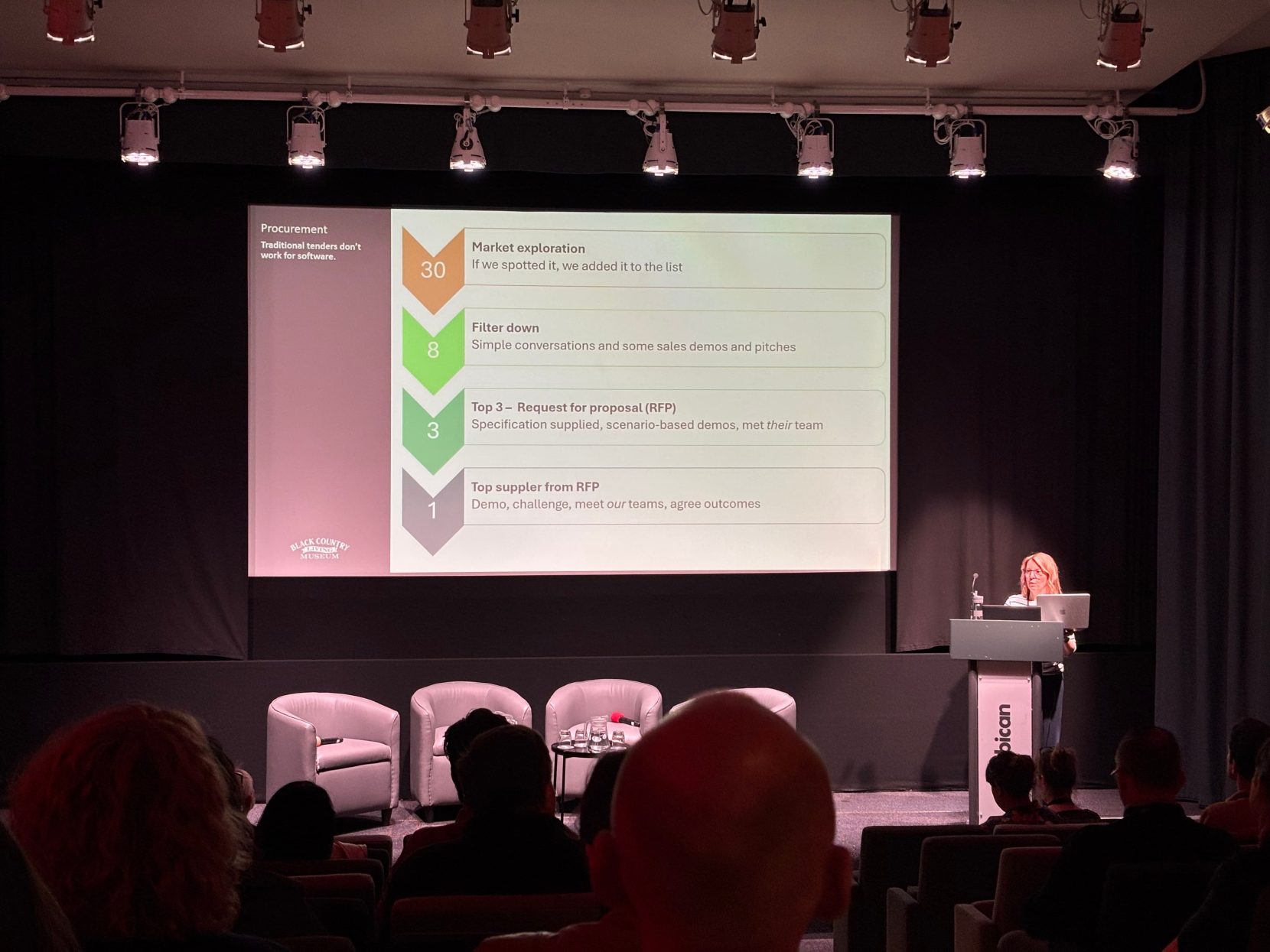
Sam Davies, Systems & Processes Business Manager at the Black Country Living Museum, talked about how to design an efficient procurement process. I really liked this talk since it showed some real thought behind making an effective and fair procurement process.
Funding from Bloomberg Digital Accelerator helped start a project to replace an ageing ticketing system. Sam started with desired outcomes, not systems. What do we want to fix and improve? There were things like better gift aid support, improved staff efficiency, and a platform that allows them to experiment.
Sam and her team walked in visitors shoes, reviewing the user journey for buying a ticket, noting what they do and what systems this touches.
They ran surveys to get feedback from people post-visit. And a workshop with internal teams to work out requirements, trying to prioritise, understanding must-haves and what they don’t need. Sam noted teams inevitably marked everything as must-have and it was hard to prioritise!
This resulted in a specification and brief, focusing on outcomes.
The procurement process itself seemed very efficient. They started with market exploration and research (30 suppliers). This was then filtered down via calls to 8 and the RFP process was undertaken with the top 3 suppliers. Sam noted don’t be afraid to ask lots of questions and really test the systems.
It’s good to see an outcome-focused approach to procurement and a realistic number of suppliers asked to take part in the RFP. Procurement can often be an over complex process. I think talking to suppliers is an essential part of an RFP process.
Proper research and an efficient, fair shortlisting process is a great way to run procurement. I’m sure Black Country Living Museum are now benefiting from this hard work.
Sam ended with key reflections:
- Plan and test end-to-end (everything is connected and needs testing).
- Change is hard (change management, helping people adapt).
- People are key to success.
- Start with outcomes, not systems. Easy to get drawn into features & functionalities. Be clear about what success is.
Using generative AI in gallery settings
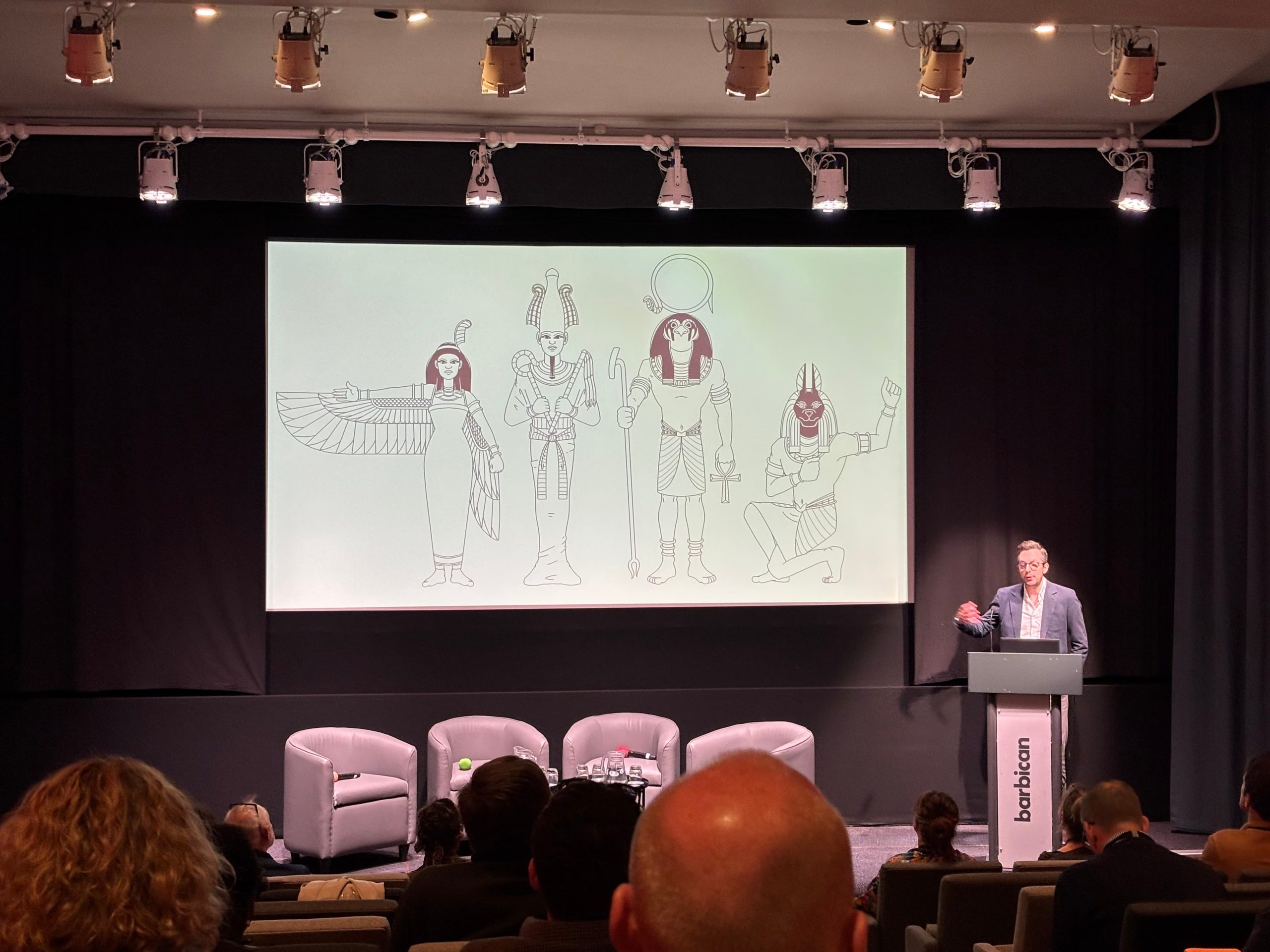
Richard Cole, Senior Lecturer at the University of Bristol, and Mark Pakjak, Head of Transformation at Bristol Culture, had an interesting talk about AI powered characters in museum spaces.
Funded by Digital Catapult, they created CultureQuest: a location based game at Bristol Museum about Egyptian gods. Developed with local gaming company Meaning Machine using their AI platform to help manage the game content.
Bristol Museum wanted to explore how to use AI ethically, they wanted to co-design it to ensure the content is accurate and representative of the museum, and they wanted it to help drive repeat visitors. Is it possible to use AI to help create an accessible, scalable solution using mobile devices?
CultureQuest is centred around 4 Egyptian gods: Osiris, Anubis, Ma’at and Ra. These characters were put into spaces in the museum. Visitors were given devices with the game app installed. By scanning a QR code the character starts talking to you, giving you a quest to explore the museum. Content for the characters was managed via Meaning Machine’s ConversationCreator software, and was reviewed by curator Amber Druce to ensure quality.
They ran a study with 40 volunteers, half of which completed the quest game individually, the rest in groups. Those in groups found it easier, and they tweaked the quest game for a second study to make it easier for individuals to complete.
One learning was users wanted to use loan devices, people didn’t want to be on their phone in a museum space and they didn’t want to download an app.
It was an interesting case study where an experienced games company was able to collaborate with academics and a museum to create an engaging, fun quest game for visitors. AI chat can often have risks due to its probabilistic nature (it’s hard to fully control). It sounded like Meaning Machine’s experience at conversational AI helped ensure success.
Getting social
After a pleasant lunch break, where I chatted to a few attendees over sandwiches, Joe Vaughan, Marketing Lead of The Museum of English Rural Life (MERL) talked to us all about social media.
I’ve heard Joe talk before at the Museums Computer Group conference, he has a witty, light-hearted approach which reflects how he manages social media for MERL. He talked about how MERL became Twitter-famous with the look at this absolute unit sheep tweet.
He noted social media is a bit of an unnecessary term these days, since it’s just media now. Social media is the main way people consume media (GWI Connecting the Dots report), however Ofcom reported active engagement on social media has dropped from 61 to 49%.
Joe sees social media as a display space that can reach millions of people worldwide.
Encouragingly, he noted museums have a superpower when it comes to social media. It’s all about telling stories and museums are specialised in telling stories in their niche.
He described social media algorithms as a black box, try not to worry about it and focus on the skills and stories you have. Try things out, experiment. Figure out how to best match your stories to the appropriate social media channels.
On the different channels, Joe had a thing to say about X (ex Twitter). His belief is no arts organisation should be on X today, a position I’d agree with due to the toxic way that platform is run.
He gave a quick overview of the useful channels:
- Short-form video: TikTok, Instagram, YouTube Shorts. This has the highest potential at present, adapt your content for the platform. Good examples include Royal Armouries Museum, Black Country Living Museum, National Gallery, and RSPB.
- Microblogging: Threads, Bluesky. Good examples are National Trust, The Mary Rose Museum, and of course MERL!
- Mixed: Facebook, LinkedIn. Good examples include Shakespeare’s Globe, The Tank Museum.
In a Q&A he noted it’s best to do one channel well and to only expand into multiple platforms if you have the resources to cover this properly. Social media is hard to do and can be a demoralising space to work in. Support your social media staff.
His key tips are:
- Focus on interesting stories (your biggest strength)
- Empower your staff
- Have fun!
Unlocking the potential of online collections
Laura Gibson, Fashion Museum Bath, and Gabby Shiner- Hill, Digital fellow at Bath University, talked about the Explore the Collection project.
Fashion Museum Bath is in the middle of a transformation project, which sees them currently without a physical venue while their new museum prepares to open in 2030. The challenge is how to make their collection available to people digitally.
Arts Council England funded a prototype project to help them explore what is possible. They embarked on an 11-month project to create Explore the Collection, initially focussing on digitising the Dress of the Year Collection (around 500 objects).
They worked directly with young people aged 16–24 through co-design workshops and user testing sessions to explore how people want to browse the collection. They also worked with experts on a copyright policy, an important topic for the collection with living designers.
This co-design, research-led approach resulted in a successful digital product which is published at https://collections.fashionmuseum.co.uk/
It’s good to hear about a project which involves users in the end product, and one where digital has become really important while the physical museum is inaccessible.
Panel discussion: A pragmatic conversation about AI
The final session was a much-anticipated panel on AI. Ash moderated the discussion with Graham Davies of Amgueddfa Cymru – Museum Wales, Janey MacRae-Tym of Science Museum Group, and Andrew Ellis of Art UK.
Ash kicked things off by asking how panellists felt about AI. Janey is new to the role of Chief Digital Officer; she’s positive about how AI can help staff and bring stories alive. Interestingly, her job description noted the Science Museum was looking for an AI evangelist. Graham and Andrew are excited by the opportunity, but want to use it responsibly.
Ash gave a quick bit of background on decades of AI tools, but the recent rise of generative AI tools has changed the conversation.
On opportunities and risks, Janey talked about AI in estate management to help with sustainable use of resources and analysing their collection to find new connections and themes. Andrew talked about how this team is broadly positive about AI. They used AI to help automatically crop 1000s of images and to help work out what themes of artwork are selling well, then create content to focus on this.
Ash asked about external focus/audience engagement? Talk moved to AI visibility, how is AI affecting visitor traffic (Science Museum has seen a negative impact), how do we report on visitor numbers, and how do LLMs perceive us as a brand? There’s the use of AI to tag images, using humans to review this. Museum Wales is working on an AI visitor guide, driven by voice. Andrew noted working with a consultant to help use green technology better (good to see a focus on sustainability).
Ash asked about the elephant in the room: ethics & sustainability of AI. He noted you need to be engaged with the technology so you can use it appropriately. The Museums Association has a session on this topic at their autumn conference.
From looking at the audience questions, there was a lot of concern about ethics, job security and sustainability. This was an area I wasn’t convinced the panel answered satisfactorily, which I think simply highlights how complex an area AI is and how hard it is to get to grips with the negative impacts and risks AI creates.
Some good points were raised. Graham noted they’re not using it frivolously; they don’t use it for image generation on the fly. Janey pointed out that one of her values is telling authentic stories, which may jar with AI. They want to use it ethically and ensure what it creates is accurate (a hard problem to solve with genAI). It was noted that all digital can use a lot of energy. Andrew noted transparency is key; be clear to your audience where you are using AI. He also said they want to keep their offering as human as possible.
Discussion moved on to AI policies and who creates these. While sometimes this comes from IT, there was a consensus that AI policies need exec-level ownership since it raises questions of ethics and governance. The Art Fund has a public AI policy, which I think is really helpful to the wider industry.
Janey talked about how guidance is important too. She wants to set up a green list for AI rather than dos and don’ts (this is a really good idea). You need to support staff to use it ethically.
Ash asked about digital sovereignty. With the French government moving away from US big tech platforms, how important is this in the UK? The general consensus is that this isn’t really something being considered at present. Are there EU or UK players with the same breadth of functionality as US firms? Andrew suggested it will become more important in the future to buy in guidance to help work out what tools to use.
Ash finished off by encouraging the audience to share their discussions about AI. This will help us all.
And what does the future hold? Speed of change, help us tell hyper personalised stories, keeping the human side of this, be transparent & responsible, working together.
Final thoughts
It was a good, stimulating day at a nice venue with a good range of speakers across the museum industry.
It was good to hear how museums are using user research and co-design to create their digital products. Although AI is a complex topic and people may be starting to engage with the ethical issues, it’s good to hear about a human approach to AI.
The importance of storytelling was a thread across many talks, and it’s clear this is a superpower of museums (as Joe put it) and something to invest more in.
A lot of the talks illustrated the importance of spending more time thinking at the start of projects.
Governance was also a recurring theme, from exec ownership on AI policies to copyright policies, which are important to get right with large collections.