How to work with AI alt text generators
Images are often used to complement text on websites and in social media posts. They are chosen carefully to convey additional meaning and help us to engage our audiences.

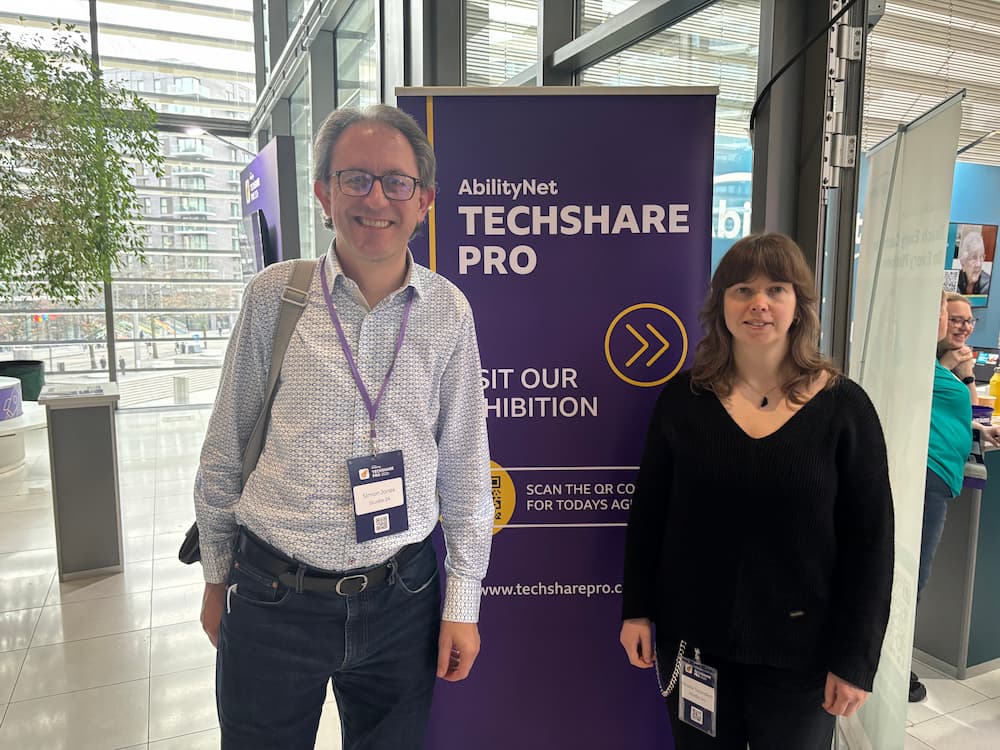
The event spans two days, with a mixture of keynote and lightning talks, panels, breakout sessions and demonstrations. This was my first year attending and, as you can probably guess, AI was a dominant theme throughout.
Some of the talks and discussions highlighted how accessibility is valuable for AI itself. Jen Jones, CMO at Siteimprove, noted the following as being crucial for AI visibility or answer engine optimisation (AEO):
This is no different to the advice that was being given years ago to businesses wanting to improve their SEO. It underlines the point that good semantic HTML and well-structured content benefit users of assistive technology, search engine spiders and AI.
Geri Reid, Lead Accessibility Specialist at Just Eat, discussed how AI is accidentally making documentation more accessible. I wasn’t able to attend that talk, but it was referenced later that day by Dylan Barrell, CTO at Deque, during his workshop “Inside the AI software factory: where accessibility is won or lost”.
Dylan paraphrased Geri when stating that AI agents are very good at reading and understanding things, but they can’t understand what you haven’t told them. Where humans can “fill in the gaps”, AI can’t do that and will struggle with documentation that humans can cope with, whether that’s down to ambiguities, a lack of precision or different terminologies being used for the same thing. If instructions are not very precise, complete and free of contradictions, AI agents will “churn”, going round in circles trying to resolve gaps they can’t fill.
The happy accident is that, in writing documentation AI agents can follow, teams end up with clearer, more precise and more consistent instructions. That benefits humans too, including people with cognitive disabilities and those reading in a second language.
In his experience, Dylan has found that large language models (LLMs) are getting better at building isolated components with good accessibility, so long as they are prompted to do so. However, accessibility still falls apart when those components are bolted together across an entire user journey.
Dylan stressed that, for an outcome that really works for everyone, usability needs to be considered alongside accessibility compliance during the planning phase. Again, I’d say this applies just as much to humans using design systems and component toolkits as it does to AI.
Bringing the focus back to humans, Lainey Feingold, Disability Rights Lawyer, and Reginé Gilbert, Industry Associate Professor at New York University, gave a lightning talk about the book “Digital Accessibility Ethics” and why ethics is a boardroom issue for AI and accessibility.
The book’s introduction notes that over 63% of the global population uses the internet, and even more people own a mobile device. Yet over 1 billion people with disabilities across the world struggle with technology and content they cannot easily use, or use at all, because of a lack of accessibility.
The authors and editors argue that, given the seeming lack of progress in digital accessibility over the past three decades, despite the business and legal arguments put forward in that time, perhaps we need to consider another strategy. They believe that ethics can help address the digital accessibility gap, shifting focus away from checklists and back towards actually meeting the needs of disabled people. They present the case for a Digital Accessibility Ethics Framework:
Accessibility touches on the common worries of CEOs, just under different guises, e.g. spending and vendors, regulation, legacy etc. Boards are considering where they can lean on AI for handling decisions. When advocating for accessibility, focusing on compliance gets you in the room after the event. Ethics gets you in before.
This matters all the more because AI bias is a well-documented problem, with disabled people being underrepresented or appearing as outliers in foundational data. This risks AI introducing problems at scale that impact large numbers of people.
Reginé described AI as the new missing ramp. A building without a ramp isn’t neutral – it’s a decision about who gets in. That’s why it’s so important to pause, early on and regularly thereafter, and ask whether we are still meeting our values.
AI provokes strong opinions, and I have a few of my own. One source of frustration is when it’s used as a shortcut for work that people should be doing themselves. Take image alt text, for example. AI can tell you what’s in an image, but good alt text explains why the image is there, and only the person who chose it really knows that.
While AI description can be a lifeline for disabled people navigating content that is completely missing image alt text, that’s a reason for authors to do better, not an excuse to hand the job over. Disabled people should not have to rely on AI as compensation for a lack of human accessibility effort. This is especially true given AI’s non-trivial impact on energy and water consumption – just two of its many serious downsides.
If there was one thread running through TechShare Pro, it’s that AI doesn’t change what good accessibility looks like, but it does raise the stakes. Clear structure, adaptable design and genuine involvement of disabled people have always mattered, and they matter even more when AI can repeat our choices, good and bad, at scale. So before reaching for the next AI tool, it’s worth borrowing the question at the heart of the Digital Accessibility Ethics Framework: who are we excluding if we stay on the current path?